
Air Compressor for PET Blowing Industry
In the PET bottle-blowing sector, the air compressor plays a central role, driving the production process. It provides the high-pressure air to expand the heated PET preform into the intended bottle shape. Our oil-free air compressor solution is tailor-made for the specific needs of the PET bottle-blowing industry.
Opt for Our Oil-Free Air Compressor for Your PET Bottle Blowing Operations
In the PET bottle blowing industry, air compressors serve as essential equipment, playing a vital role in the blow molding of PET preforms to ensure the quality and uniformity of the final bottle. The production process relies heavily on high-quality compressed air to maintain safety standards and clean packaging, directly impacting the hygiene of food and beverages. We confidently present our oil-free air compressor solution, specially engineered to meet the rigorous demands of PET bottle blowing production. Our compressors deliver not only stable and pure air but also offer superior energy efficiency and minimal maintenance requirements, optimizing your production line and reducing overall ownership costs. By choosing our solution, you are opting for reliability, enhanced productivity, and a commitment to food safety, helping your business excel in a competitive marketplace.
PET Air Compressor
Not PISTON
No more high noise and vibration
SCREW TYPE
Patented Two-stage single-screw compression
More than 20 years experience
Not BOOSTER
No more high maintenance costs
Recommended Products:
| model | Working Pressure | flow | power | noise | weight | Dimensions | |||
|---|---|---|---|---|---|---|---|---|---|
| MPa | Psi | m³/min | cfm | kW | HP | dB(A) | kg | L*W*H | |
| mm | |||||||||
| CM08PVF | 0.8 | 116 | 0.45-1.15 | 16-41 | 7.5 | 10 | 58 | 630 | 1550×775×1445 |
| 1 | 145 | 0.41-1.02 | 14-36 | 500 | 1350×774×1150 | ||||
| CM11PVF | 0.8 | 116 | 0.62-1.55 | 22-55 | 11 | 15 | 58 | 650 | 1550×775×1445 |
| 1 | 145 | 0.53-1.32 | 19-47 | 520 | 1350×774×1150 | ||||
| 1.25 | 181 | 0.48-1.02 | 17-36 | ||||||
| CM15PVF | 0.8 | 116 | 0.96-2.40 | 34-85 | 15 | 20 | 63 | 900 | 1900×1000×1635 |
| 1 | 145 | 0.85-2.12 | 30-75 | ||||||
| 750 | 1680×1000×1335 | ||||||||
| 1.25 | 181 | 0.64-1.61 | 23-57 | ||||||
| CM18PVF | 0.8 | 116 | 1.24-3.10 | 44-109 | 18.5 | 25 | 65 | 970 | 1900×1000×1635 |
| 1 | 145 | 1.05-2.62 | 37-93 | ||||||
| 820 | 1680×1000×1335 | ||||||||
| 1.25 | 181 | 0.85-2.13 | 30-75 | ||||||
| CM22PVF | 0.8 | 116 | 1.40-3.50 | 49-124 | 22 | 30 | 65 | 1000 | 1900×1000×1635 |
| 1 | 145 | 1.25-3.13 | 44-111 | ||||||
| 850 | 1680×1000×1335 | ||||||||
| 1.25 | 181 | 1.04-2.61 | 37-92 | ||||||
| CM30PVF | 0.8 | 116 | 2.00-5.00 | 71-177 | 30 | 40 | 66 | 1150 | 1950×1050×1780 |
| 1 | 145 | 1.68-4.20 | 59-148 | ||||||
| 1080 | 1900×1050×1430 | ||||||||
| 1.25 | 181 | 1.52-3.18 | 54-112 | ||||||
| CM37PVF | 0.8 | 116 | 2.44-6.10 | 86-215 | 37 | 50 | 67 | 1170 | 1950×1050×1780 |
| 1 | 145 | 2.09-5.22 | 74-184 | ||||||
| 1100 | 1900×1050×1430 | ||||||||
| 1.25 | 181 | 1.92-4.81 | 68-170 | ||||||
| CM45PVF | 0.8 | 116 | 3.12-7.80 | 110-275 | 45 | 60 | 68 | 1930 | 3040×1280×1800 |
| 1 | 145 | 2.45-6.13 | 87-216 | ||||||
| 1430 | 1880×1260×1430 | ||||||||
| 1.25 | 181 | 2.26-5.65 | 80-200 | ||||||
| CM55PVF | 0.8 | 116 | 3.84-9.60 | 136-339 | 55 | 75 | 70 | 2050 | 3040×1280×1800 |
| 1 | 145 | 3.44-8.60 | 121-304 | ||||||
| 1550 | 1880×1260×1430 | ||||||||
| 1.25 | 181 | 2.97-7.42 | 105-262 | ||||||
| CM75PVF | 0.8 | 116 | 5.16-12.90 | 182-455 | 75 | 100 | 73 | 2450 | 3040×1280×1800 |
| 1 | 145 | 4.57-11.42 | 161-403 | ||||||
| 1790 | 1880×1260×1430 | ||||||||
| 1.25 | 181 | 3.93-9.83 | 139-347 | ||||||
| CM90PVF | 0.8 | 116 | 6.52-16.30 | 230-576 | 90 | 125 | 73 | 2160 | 2500×1400×1580 |
| 1 | 145 | 5.81-14.52 | 205-513 | 2160 | |||||
| 1.25 | 181 | 4.92-12.30 | 174-434 | ||||||
| CM110PV | 0.8 | 116 | 7.76-19.40 | 274-685 | 110 | 150 | 78 | 2270 | 2500×1400×1580 |
| 1 | 145 | 6.76-16.90 | 239-597 | ||||||
| 1.25 | 181 | 6.04-15.10 | 213-533 | ||||||
| CM132PV | 0.8 | 116 | 8.88-22.21 | 314-784 | 132 | 180 | 78 | 2350 | 2500×1400×1580 |
| 1 | 145 | 8.15-20.38 | 288-720 | ||||||
| 1.25 | 181 | 7.31-18.29 | 258-646 | ||||||
| CM160PV | 0.8 | 116 | 11.54-28.85 | 407-1019 | 160 | 220 | 78 | 3720 | 3100×1700×2090 |
| 1 | 145 | 9.81-24.52 | 346-866 | ||||||
| 1.25 | 181 | 8.87-22.17 | 313-783 | ||||||
| CM200PV | 0.8 | 116 | 14.65-36.63 | 517-1293 | 200 | 270 | 78 | 3750 | 3100×1700×2090 |
| 1 | 145 | 13.10-32.70 | 463-1155 | ||||||
| 1.25 | 181 | 11.09-27.72 | 392-979 | ||||||
| CM250PV | 0.8 | 116 | 17.15-42.88 | 606-1514 | 250 | 340 | 78 | 3900 | 3100×1700×2090 |
| 1 | 145 | 15.60-39.00 | 551-1377 | ||||||
| 1.25 | 181 | 13.87-34.64 | 490-1223 | ||||||
| CM320PV | 0.8 | 116 | 23.64-59.10 | 835-2087 | 320 | 430 | 80 | 4850 | 3600×2800×2000 |
| 1 | 145 | 21.40-53.50 | 756-1889 | ||||||
| 1.25 | 181 | 19.30-48.25 | 681-1704 | ||||||
The Process of PET Bottle Blowing Industry
Principles of the PET Bottle Blowing Process
The PET bottle blowing process relies on the physical behavior of polymers. When heated, PET particles melt and stretch, forming a thin film. This technique, known as biaxial stretching, improves the mechanical properties of the bottle wall, boosting its tensile, stretching, and impact strength. Additionally, it enhances the bottle’s sealing capabilities.
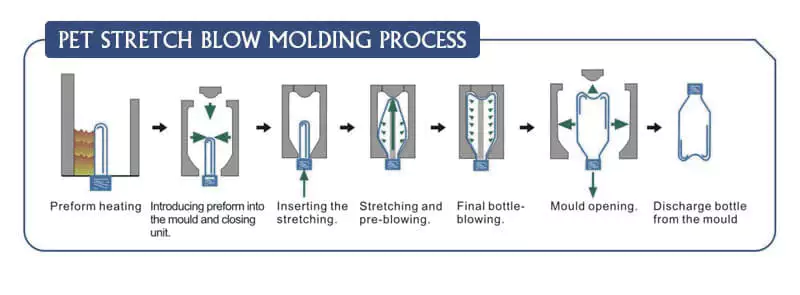
PET Blow Molding Industrial Process

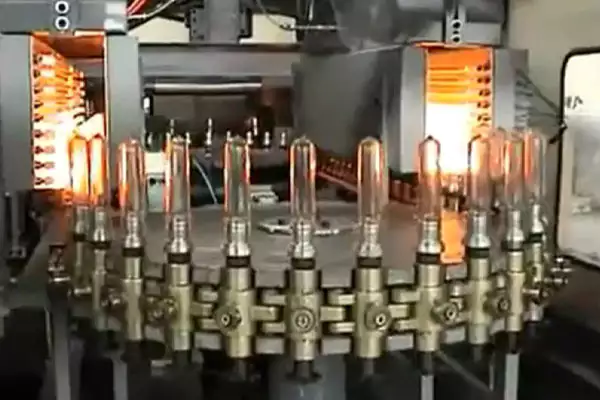

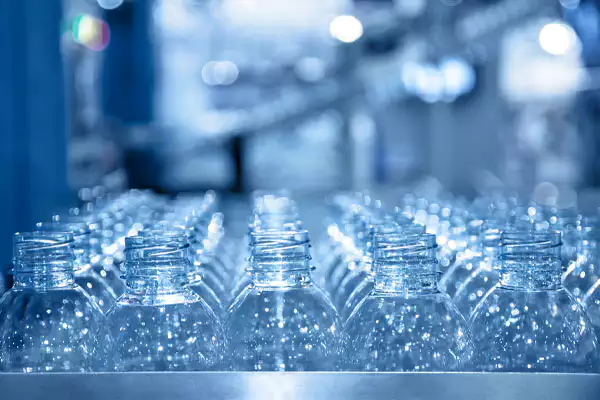
Preform preparation
PET particles are initially heated and molded into what is known as preforms. These preforms feature a bottleneck shape, while the remainder of the structure is cylindrical.
Heating
The preform is heated using an infrared high-temperature lamp to achieve the optimal temperature and plasticity required for the blow molding process.
Blow molding
The preform is placed into the mold, where the air compressor starts its operation. High-pressure, oil-free compressed air is then injected into the preform, expanding it to fit the mold and forming the final bottle shape.
Cooling & solidification
The bottle is cooled and solidified within the mold to achieve a stable form. To prevent deformation of the bottle neck, it is typically not heated during the blow molding process, and a cooling system is used to keep it at a low temperature.
Demolding & processing
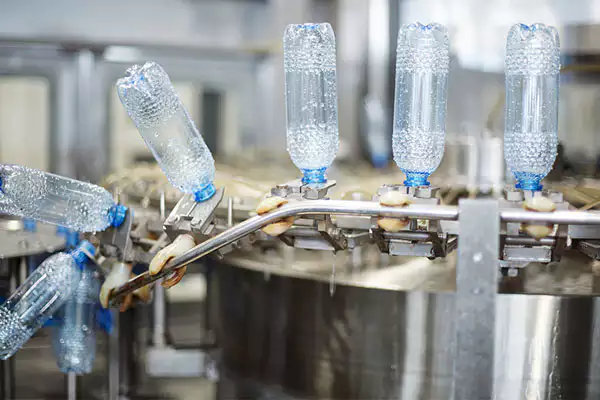
After cooling is completed, the bottle is removed from the mold and may require further processing, such as cleaning, inspection, printing, or labeling.
The Role of Air Compressor in PET Bottle Blowing Industry
Throughout the entire PET bottle blowing process, the air compressor plays a vital role during the blow molding stage. It needs to deliver adequate compressed air pressure to swiftly and uniformly shape the preform into the desired bottle form. The quality of the compressed air—free from oil, moisture, and contaminants—directly impacts the bottle’s quality. Any impurities can lead to defects or compromise hygiene. This is particularly critical in the food and beverage packaging industry, where oil-free compressors are essential to ensure the final product adheres to food safety standards.
Blow Molding:
In the blow molding process, the air compressor supplies high-pressure compressed air to expand the heated PET preform into the mold, shaping the bottle. This step is essential in PET bottle production, as the air pressure must be strong enough to overcome the preform’s resistance, ensuring it adheres closely to the mold walls to form the desired shape.
Biaxial Stretching:
During blow molding, the PET material undergoes biaxial stretching, where it is simultaneously stretched both longitudinally and transversely. The high-pressure air from the compressor facilitates this process, enhancing the bottle’s strength and durability.
Oil-Free Operation:
In industries such as food and beverage packaging, it is critical that compressed air is oil-free to prevent contamination. Oil-free air compressors are essential in PET bottle manufacturing, delivering clean compressed air to ensure the final product meets strict hygiene and safety standards.
Pressure Regulation:
Accurate control of compressed air pressure is crucial for ensuring consistent wall thickness in bottles. Low pressure can lead to incomplete formation, while high pressure might cause deformation or breakage. Therefore, the compressor must deliver a stable and precise pressure output.
Cooling and Pressure Maintenance:
Post-blow molding, compressed air assists in the cooling phase, helping the bottle retain its shape until it fully cools and solidifies. Maintaining constant pressure during the cooling phase is also vital for the bottle’s stability and capacity.
Enhancing Production Efficiency:
A high-performance air compressor provides the necessary compressed air to support rapid production rates, thus boosting the overall output of the bottle blowing production line.
Environmental and Energy Efficiency:
Modern air compressors are designed with a focus on energy efficiency, reducing power consumption, lowering operational costs, and minimizing environmental impact.
Why Choose Our Air Compressor?

High Efficiency And Energy Saving

High Purity Compressed Air

Reliability And Durability

Low Maintenance Cost
In general, compressed air should be purified before use to eliminate contaminants. Common pollutants include solid particles, water vapor, moisture, and oil vapor, particularly in systems handling lubricating oil, pipelines, air tanks, and oil-injected air compressors.
When compressed air is used in direct contact with drinking water, beverages, or edible oils, it is crucial to ensure its purity and cleanliness to avoid contamination. The following steps should be taken:
Moisture Removal:
Moisture encourages the growth of microorganisms and fungi. If moisture is present in the compressed air lines, it can be transferred onto the product, packaging, or containers. To prevent this, a dryer is essential to achieve the necessary dew point. For compressed air in direct contact with products, the dew point should reach -40°C, usually achieved with a desiccant dryer. For low-risk, non-contact air, a dew point of 3°C is sufficient, typically using a refrigerated air dryer.
Oil Removal:
Even if using an oil-free compressor, there is oil vapor present in the air due to natural atmospheric conditions. To address this, a filter is required. Oil-free compressors must be used for air that comes into direct contact with products, ensuring Class 0 purity—100% oil-free air—eliminating any health risks tied to oil contamination. For non-contact applications, oil-lubricated compressors may be used with a filter to maintain an oil content of 0.003 ppm.
Particle Removal:
The atmosphere contains solid particles and dust that could lead to contamination when in contact with the product. Additionally, particles may originate from the internal components of the compressor system. A filter is necessary to ensure the particle size does not exceed 0.01μm.
Pure oil-free water-lubricated screw air compressor VS traditional dry oil-free screw air compressor
Overall benefits:
| Water-lubricated oil-free air compressor | Conventional dry oil-free air compressor | |
| Operational reliability | Water lubrication reduces wear and heat build-up, providing stable operation. | The absence of lubricants leads to higher wear and heat build-up, which can increase the risk of failure. |
| noises | The water lubrication system reduces machine vibration and noise, providing a quieter working environment. | The non-lubricated system produces more vibration and noise, and the working environment is noisy. |
| Compression efficiency | Water cools the compressed air, improves energy efficiency, and produces more compressed air. | Lack of water cooling effect, energy efficiency is slightly lower than water lubricators. |
| Air quality | Water filters impurities from the air, providing clean, pure compressed air. | No anhydrous filtration mechanism, may contain more impurities, and the air quality is slightly lower. |
| Energy saving and environmental protection | The water lubrication system does not need to use lubricating oil, which avoids the consumption and discharge of lubricating oil, and meets the requirements of energy conservation and environmental protection. | Critical components need oil for lubrication |
| Service life | Water lubrication reduces wear on screws and bearings and extends the life of the equipment. | Relying on the rotor coating, the service life is uncontrollable. |
| Wide range of applications | It is suitable for industries with high requirements for compressed air quality, such as food, pharmaceutical, etc. | Due to the risk of oil leakage with long-term use, it is not suitable for industries with high requirements for air pharmaceuticals. |
Structural advantages:
| Water-lubricated oil-free air compressor | Conventional dry oil-free air compressor | |
| Volumetric efficiency | There is a water seal, high efficiency | Gaps exist, and the efficiency is low |
| Transmission mode | The motor is directly connected, and the mechanical loss is small | Speed-increasing gear, large mechanical loss |
| Compression chamber temperature | Low temperature compression (less than 50 degrees Celsius) | High temperature compression (200~300 degrees Celsius) |
| Stress condition | Ideal force balance compression, the maximum pressure can reach 4.0Mpa | The axial and radial forces are unbalanced and cannot provide high-pressure compressed air |
| Motor speed | The rotational speed is only 3000 rpm, the noise is low, and the component life is high | Up to 10,000-20,000 rpm with low bearing life |
Compressed air quality advantages:
| Water-lubricated oil-free air compressor | Dry oil-free air compressor | |
| Oil-free safety | It is lubricated with water and has no oil guarantee for life | Aging of the seal ring can lead to the risk of oil leakage |
| water content | The temperature is low and the compressed air has a low moisture content | The temperature is high and the compressed air has a high moisture content |
| Impurity profiles | Pure water cleans the compressed air, and at the same time, there is a water filter air filter for filtration, and the compressed air has low impurities | There is no filtration system and the impurity content is high |
Running costs and other benefits:
| Water-lubricated oil-free air compressor | Dry oil-free air compressor | |
| Running electricity bills | Low, taking the 55kW model as an example, the power consumption per hour is 8.8kW lower | high |
| Maintenance consumables | Water filter, air filter | Lubricating oils, oil filters, seals, air filters, rotor coatings |
| Maintenance costs | Low, taking 55kw as an example, the annual maintenance cost is not higher than 3000 yuan. | High, taking 55kw as an example, the annual maintenance cost is about 15,000 yuan, and then it will increase year by year, and the rotor coating maintenance will exceed 50,000 yuan after three years. |
How to Choose Air Compressor Suitable for PET Bottle Blowing?
Choosing an air compressor suitable for the PET bottle blowing industry is a key decision that directly affects production efficiency, product quality, and operating costs. The following are the main factors to consider when choosing an air compressor:
Compressed Air Quality:
- Oil-Free Compression: The PET bottle blowing industry typically relies on oil-free compressors to prevent oil contamination in the compressed air, which can affect the final product and cause damage to equipment.
- Purity and Dryness: Compressed air must be properly filtered and dried to remove moisture, dust, and impurities, ensuring both the cleanliness of the bottles and the reliability of the production process.
Pressure Level:
To meet production requirements, PET blow molding generally demands high-pressure compressed air, often around 3.0 MPa or more, to ensure the preform is fully shaped into the bottle.
Airflow Rate:
It’s essential to assess whether the compressor’s maximum airflow rate can meet the production line’s needs, particularly during peak operating times, to ensure a continuous supply of compressed air.
Energy Efficiency and Cost:
- Energy Efficiency: Opting for a compressor with high energy efficiency can significantly reduce electricity costs over time.
- Total Cost of Ownership: Beyond the initial purchase price, factors like maintenance, energy consumption, and the expected lifespan should also be taken into account to get a clear picture of long-term costs.
- Compressor type:
Oil free piston compressor: suitable for high-pressure, medium and small flow applications.
Oil free screw compressor: suitable for high flow and continuous operation, with high reliability and energy efficiency.
Centrifugal compressor: suitable for extremely high flow and medium pressure requirements, but with high initial investment. - System integration and control:
Consider the compatibility between the compressor and existing production lines, as well as whether there is an intelligent control system, such as variable frequency drive (VFD), to achieve on-demand gas supply and reduce energy waste. - Maintenance and after-sales service:
Confirm the maintenance needs of the compressor and the replacement cycle of vulnerable parts, as well as the warranty and support services provided by the manufacturer. - Environmental conditions:
Consider the operating environment of the compressor, such as temperature, humidity, and installation space, and choose a compressor model that is suitable for the site conditions. - Industry certification and standards:
Ensure that the compressor complies with relevant industry standards and safety regulations, such as ISO 8573-1 air quality standards.
 English
  Korean
  Chinese
  Japanese
  German
  Hindi
Hindi  French
  Italian
  Portuguese
  Russian
  Spanish
  Indonesian
  Dutch
Dutch  Arabic
  Turkish
  Polish
  Swedish
  Malay
Malay  Tamil
Tamil  Malayalam
  Norwegian
  Persian
  Ukrainian
  Vietnamese
  Urdu
Urdu  Kazakh